
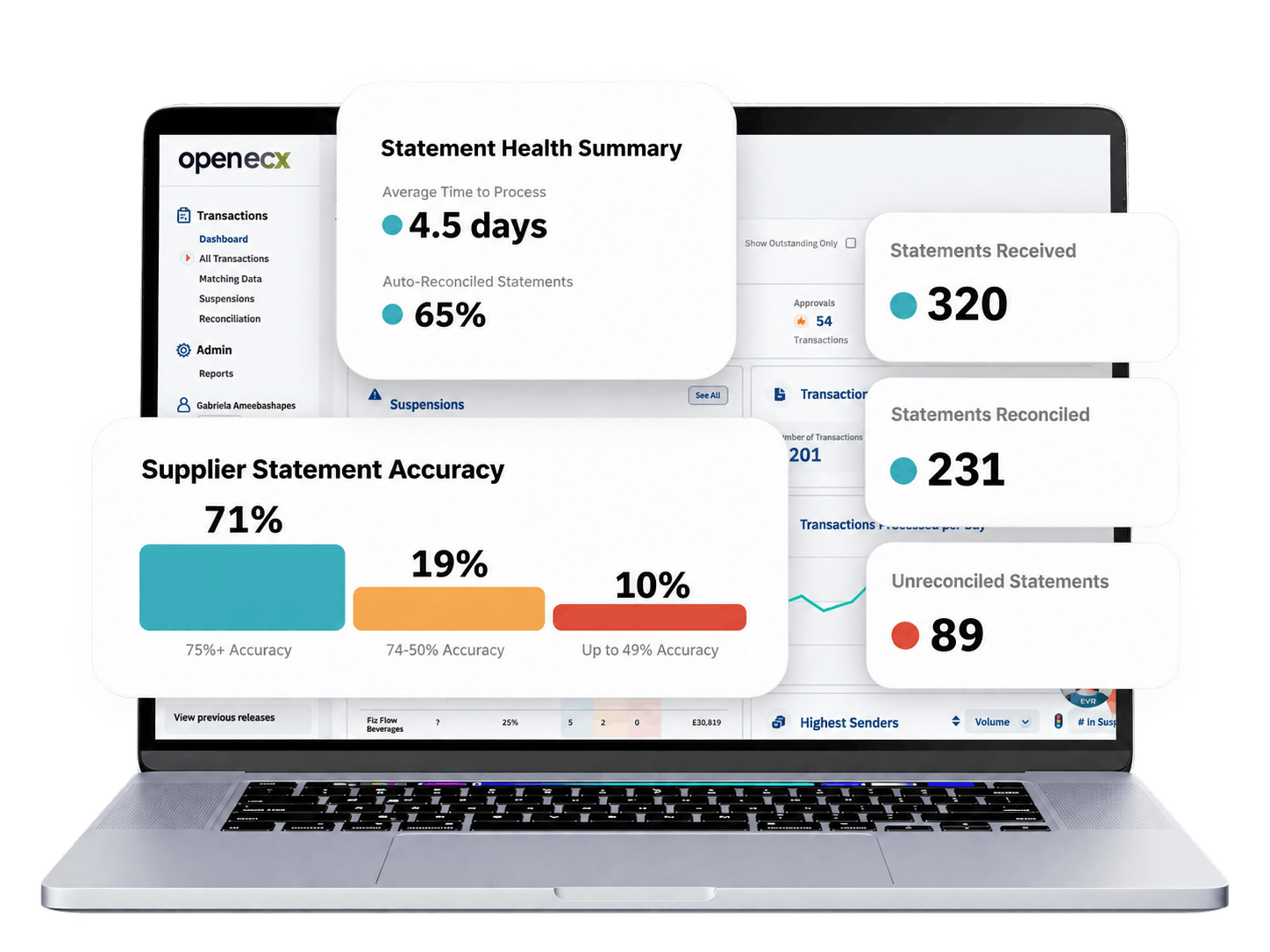
Checking every one against your ledger manually gets harder with every supplier you add. This guide pulls together everything your finance team needs on statement reconciliation: what it is, how the matching works, and what changes when you automate it. Whether you're comparing software, building the case for a project, or just want a straight answer to "what is this, really", you're in the right place.
Our guides cover what statement reconciliation is, how it works, and why it's worth automating.

We define the term, who does it and when it happens. Start here if the concept is new to you.

We walk through the six-step matching process, from raw statement to resolved exceptions, with a worked example.

We break down why a £60k headcount at 3% margin equals the profit on a £2m project, and what automation gets back.
50% reduction
Anticipated reconciliation processing time, NMBS
"This solution has been highly beneficial - we anticipate a 50% reduction in processing time, enhancing supplier relationships, and supporting Prompt Payment."
Rex Nye, Digital Director, NMBS
550 suppliers · 1,300 statements · 200,000+ invoices a month
6 hours a day
Staff time saved, Direct Heating & Plumbing
"Previously, we were manually ticking off each statement or performing VLOOKUPs in a spreadsheet to reconcile larger suppliers, which took a lot of valuable time. Now, Open ECX automatically reconciles any matching items to our ledger, and we only need to focus on any discrepancies."
Ryan Davies, Finance Manager, Direct Heating & Plumbing
Guides for the questions that come up once reconciliation is already on the agenda.

We cover missing statements, opening balance mismatches and GRNI build-up. Ten problems, ten fixes.
Three guides for teams reconciling at volume, or getting ready for an audit.

We explain what changes at 500+ statements a month, and why manual reconciliation stops scaling in a straight line.
If reconciliation got harder as you grew rather than easier, that's the surest sign a spreadsheet was never going to be the long-term answer.
The full six-step walkthrough, covering uploads, matching logic and exceptions, sits right above in this guide.
Read the walkthrough
550 suppliers, 1,300 statements and 200,000+ invoices a month, matched without the manual chase.
Read the case studyThe same reconciliation logic, shaped to how your industry works.

High transaction volumes and tight supplier terms, kept in check automatically.
View the industry page
Thousands of line items a month, matched without the manual chase.
View the industry page
Statements from every supplier, reconciled the same way every time.
View the industry page
Multi-entity ERPs, retentions and subcontractor statements, all reconciled the same way.
View the industry pageBook a demo and we'll show you exactly how it fits your ERP, your suppliers and your month end.
It's the process of comparing a supplier's statement against your own purchase ledger to confirm every invoice, payment and credit lines up. We flag anything that doesn't as a discrepancy to resolve.
Monthly is the common baseline, though high-volume suppliers often get reconciled weekly. Automation makes the frequency a setting, not a staffing decision.
Only if you're SEC-registered or a subsidiary of a US-listed parent whose results roll into that parent's accounts. Most UK private companies sit outside SOX's direct scope, though the same control discipline still pays off ahead of an audit or an exit.
Matching, flagging and reporting can run automatically. Exceptions still go to a person, which is exactly where the time should go.
Invoice matching checks one invoice against a PO and a goods receipt before payment. Statement reconciliation checks the supplier's whole statement against your ledger after the fact. One stops errors, the other catches what got through.

